
The overall air quality index was recorded at 426 which falls in the 'severe' category, according to data by the Central Pollution Control Board.

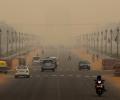
Delhi woke up to the season's worst air quality as smoke from Diwali fireworks, coupled with moisture and nearly stagnant wind movement, shrouded the city in a thick cover of smog with respirable pollutants reaching perilous levels.

The apex court also directed the Centre not to renew for possessing, stocking and selling of fire crackers licences till further orders.
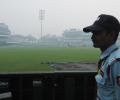
Former India cricketer Gautam Gambhir on Thursday said that no match should take place in Delhi until the pollution levels are brought under control.

The spurt in pollutants was caused by a combination of meteorological factors including a drop in temperature, wind speed and mixing height, a layer where air and particulates float, the Central Pollution Control Board said.

The air quality in the national capital remained poor for the sixth consecutive day on Monday with stubble burning accounting for seven per cent of the capital's PM2.5 pollution.
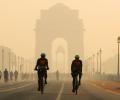
"The overall Delhi's Air Quality Index is in the very poor category with few Delhi locations entering at higher zone but that will be short lived. This is mainly because the extremely calm local surface winds which were prevailing yesterday are likely to increase slightly and may further pick-up by Oct 26," SAFAR said.

The city's 24-hour average AQI was recorded in the 'poor' category at 265 on Saturday as residents flouted the ban on firecrackers in parts of the national capital ahead of Diwali, according to Central Pollution Control Board's (CPCB) data.
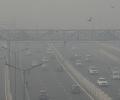
Acentral panel directed authorities to ban the plying of 4-wheeled diesel LMVs in Delhi and adjoining NCR districts and the entry of trucks into the capital.

Delhi recorded an air quality index of 315 at 11:10 am. The last time the air quality hit such a poor level was in February.

The ban on certain single-use plastic (SUP) items kicks in from Friday, with state governments initiating an enforcement campaign to identify and close down units engaging in production, distribution, stocking and sale of such items, officials said. Though several manufacturers have said they are not prepared to implement the ban due to a lack of alternatives, Union Environment Minister Bhupender Yadav had on Tuesday said the government had given enough time to the industry and the general public to prepare for the ban on SUP items and it hopes for everyone's cooperation in implementing it from July 1. Violation of the ban will invite punitive action, including a fine or a jail term or both, detailed under Section 15 of the Environment Protection Act (EPA) and under bylaws of respective municipal corporations, officials in the Union environment ministry said.

Top officials of the environment ministry, Delhi Development Authority and municipal commissioners also stayed away from the deliberations.
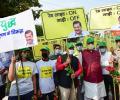
According to the Central Pollution Control Board's mobile application SAMEER, the city recorded an air quality index of 168, which falls in the 'moderate' category, much better than Monday's AQI of 221, which falls in the 'poor' category.

Less than six months ago, Delhi was gasping for breath. Authorities said air quality had reached "unbearable levels". Schools were shut, flights were diverted, and people were asked to wear masks, avoid polluted areas and keep doors and windows closed. But during the lockdown that began on Mar 22, the concentration of poisonous PM2.5 particles in a cubic metre of air averaged at 44.18, according to a Reuters analysis of government data, indicating a rare "good" rating, the safest level on the scale.

As many as 753 violators of the odd-even scheme were challaned on Monday, the 11th day of the car-rationing measure's implementation in New Delhi.
Rediff Labs has analysed Delhi region's air quality through its product real-time air quality analyser

Uncertainty looms over Lanka-Bangla World Cup clash due to severe air pollution

The Supreme Court on Wednesday refused to interfere with the Delhi government's order putting a comprehensive ban on manufacturing, storage, sale and bursting of firecrackers in the city, saying people's health is important.
The big question is whether the regulators will have the courage to prosecute the bigwigs in the cities.

As visibility remained poor and the city choked due to a haze, the Centre for Science and Environment asked the Delhi govt to roll out stringent plans for controlling winter pollution.

Welcoming the reduction in pollution, environmentalists urged the government to treat it as a "wake-up call" and stop its "obsession" with "development" at the cost of the environment.
The India Meteorological Department on Wednesday issued an orange alert for Delhi, predicting 'heavy' to 'very heavy' rainfall in parts of the capital with winds gusting up to 60 kilometers per hour.

The nationwide 'Janta Curfew' followed by the 21-day lockdown to combat the coronavirus outbreak have led to a significant reduction in pollution in the country, with 91 cities recording air quality in the 'good' and 'satisfactory' category on March 29, a Central Pollution Control Board report has stated. Travel restrictions and the closure of industries have helped reduce the pollution level, it said.
The neighbouring cities of Faridabad (469), Greater Noida (464), Ghaziabad (470), Gurgaon (472) also recorded 'severe' air pollution levels.

The air quality in Delhi is turning worse, Deputy Chief Minister Manish Sisodia said.

NHRC issues notices to Centre and governments of Delhi, Punjab and Haryana, saying 'the state cannot leave its citizens to die due to the toxic haze.'
The top court did some tough-talking and had warned that the administration at large will be made accountable even if there is a single incident of stubble burning henceforth.
The air quality in Delhi remained poor Sunday with drop in wind speed even as authorities predicted further fall in air quality index of the national capital in the coming days.
Doctors have declared the situation as a 'public health emergency', while the government has taken a series of measures in view of high pollution levels.
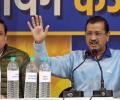
Aam Aadmi Party supremo Arvind Kejriwal went to the Election Commission's office in New Delhi on Friday and furnished his reply to the poll body over its notice to him on his 'poison mixed' in Yamuna water remark.

The Madhya Pradesh high court in Jabalpur on Monday directed the state government to take steps within six weeks for disposal of Bhopal-based Union Carbide's 337 tonnes of hazardous waste as per safety protocols, while restraining the media from publishing any fake news on the same.

Delhi Chief Minister Arvind Kejriwal hopes pollution will not affect the India-Bangladesh T20 International in the city on November 3, emphasising that his government has been taking steps such as the odd-even scheme to improve the air quality.

People stood at their places with their phone cameras open but faced trouble capturing aircraft formations due to the layer of fog and smoke cloaking the capital.

The minimum temperature in the national capital on Saturday settled at 10.2 degrees Celsius, three notches above the season's average, it said.

Officials have admitted that the problem of frothing will continue until sewage treatment plants in Delhi are upgraded to meet the new standards.

New Delhi's overall air quality index read 456 at 4 pm, up from 425 at 4 pm on Tuesday.

With CPCB saying that the air quality is not severe now, the SC partially lifted its ban.
People living in Delhi should be more concerned about pollution levels rather than hosting a cricket match, said former India opener Gautam Gambhir.

The smog reduced the visibility to merely 300 meters in the morning affecting traffic, an official of the India Meteorological Department said.

A CPCB official said a number of factors were responsible for the deteriorating air quality, including vehicular pollution, construction activities and meteorological factors.
 © 2026 Rediff.com - Advertise with us - Disclaimer - Privacy Policy - Sitemap - Feedback - About us - Terms of use - Grievances